Product overview
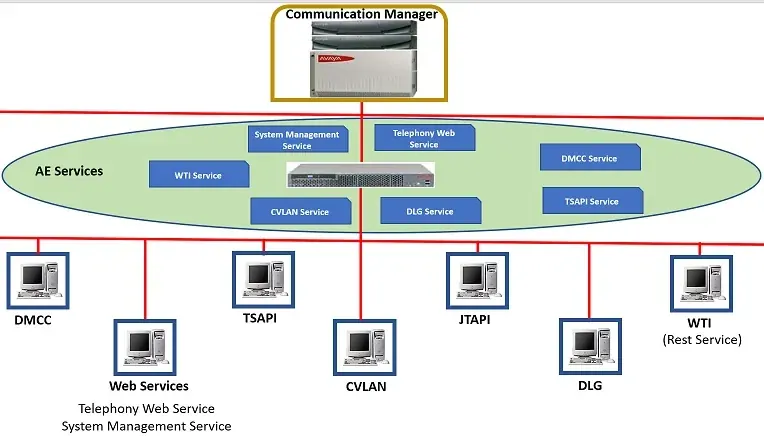
Avaya Aura® Application Enablement Services (AES) is an open platform for application integration that both supports the interface needs of existing contact center applications and provides emerging application programming interfaces (APIs). AES exposes the call and device capabilities of Communication Manager to third-party applications through APIs, protocols and web-based interfaces.
Core services and APIs
- DMCC (Device, Media, Call Control): provides first-party call control (1PCC, device and media control) and third-party call control (3PCC), with Java, XML and .NET SDKs; usable for recording, announcement playback and saving media to WAV
- TSAPI: a C/C++ third-party call control API that can control a given call or extension, route incoming calls, receive events and invoke Communication Manager features
- JTAPI: a client-side interface to TSAPI that likewise provides third-party call control
- Web Services: WSDL/SOAP abstractions that sit above the fine-grained APIs and simplify calls to common functions
- Telephony Web Service: a high-level call control interface based on SOAP/XML that hides the complexity of traditional CSTA concepts
- System Management Service: view and manage Communication Manager administration objects (display, list, add, change, remove)
- CVLAN: a C/C++ ASAI message interface (an Avaya proprietary protocol, not recommended for new application development)
- DLG (DEFINITY LAN Gateway): tunnels ASAI/Q.931 messages over TCP/IP (an Avaya proprietary protocol)
- WTI (Web Telephony Interface): integrates with enterprise applications as REST services, with its Telephony REST Service providing high-level call control. Since Release 10.2, WTI offers interfaces corresponding to all DMCC APIs
Routing and system services
- Routing Services: applications can request and receive routing instructions from a client routing server based on the incoming call information provided by Communication Manager
- System Services: queries TSAPI TLink health and pushes events (such as linkUp/linkDown) to registered applications when TLink status changes
Security features
- Role-based access control (RBAC): restrict access to administration console pages and read, change and delete operations by authorization level
- Linux account shell access control, login audit, account lock and unlock, and login reports
- All AE Services APIs can be configured as secure application links
- Pre-installed third-party certificates are for lab use only; production environments must use their own PKI or third-party certificates
Link reliability and redundancy
- AEP (Application Enablement Protocol) establishes a TLS-encrypted, secure TCP/IP channel between AES and Communication Manager, tunnelling ASAI and call information
- Link bounce resiliency: messages are not lost during network interruptions or switchovers of up to 30 seconds
- A single AES supports up to 16 AEP connections, providing redundant failover for CLAN or Processor Ethernet configurations
- Supports Enterprise Survivable Server (ESS) and Local Survivable Processor (LSP) redundancy; using the Processor Ethernet interface throughout is recommended
SIP endpoint support
AES 8.0.1 and later support J169, J179 and other SIP 2.0 telephones; third-party call control of Avaya SIP endpoints (such as J129, J139, J169, J179 and 9608/9611/9641 SIP telephones) is available through TSAPI/JTAPI rather than DLG.
Supplementary official documentation (Aura R10.3.x)
The following material is compiled from Avaya official overviews and specification documents to supplement version, component relationship and deployment details; refer to the original documents for definitive capacity and compatibility matrices.
- The R10.3.x (2026-09) document states that it lists tested features and capabilities, covering functional description, interoperability, performance specifications and security requirements.
- The document includes System Management Services capacity and application developer chapters.
- The official architecture diagram shows how AES connects to Aura applications, agents and the switch side.
Document source and download
The official document referenced here is Avaya Aura Application Enablement Services Overview and Specification R10.3.x (2026-09); the original PDF can be obtained under Product Literature in this site's Downloads section.