
Product overview
The Avaya IP Office platform is a cost-effective telephony system for mobile and distributed teams, delivering voice and video on virtually any device. It is a modular, pay-as-you-grow communications solution: multi-site networks scale to 3,000 extensions across 150 sites, with built-in redundancy.
IP Office is a hybrid PBX supporting both time-division multiplexing (TDM) and IP telephony with its trunks; the two modes can be used separately or concurrently. Data capabilities are built in, delivering IP routing, switching and firewall protection between the LAN and the WAN (LAN2) without separate data equipment.
Beyond basic calls and voicemail, IP Office offers both hard phones and softphones. A softphone lets remote staff place and answer internal and external calls, retrieve voicemail and use features such as call transfer from a PC or mobile device, adapting easily to home and mobile working.
Server Edition positioning
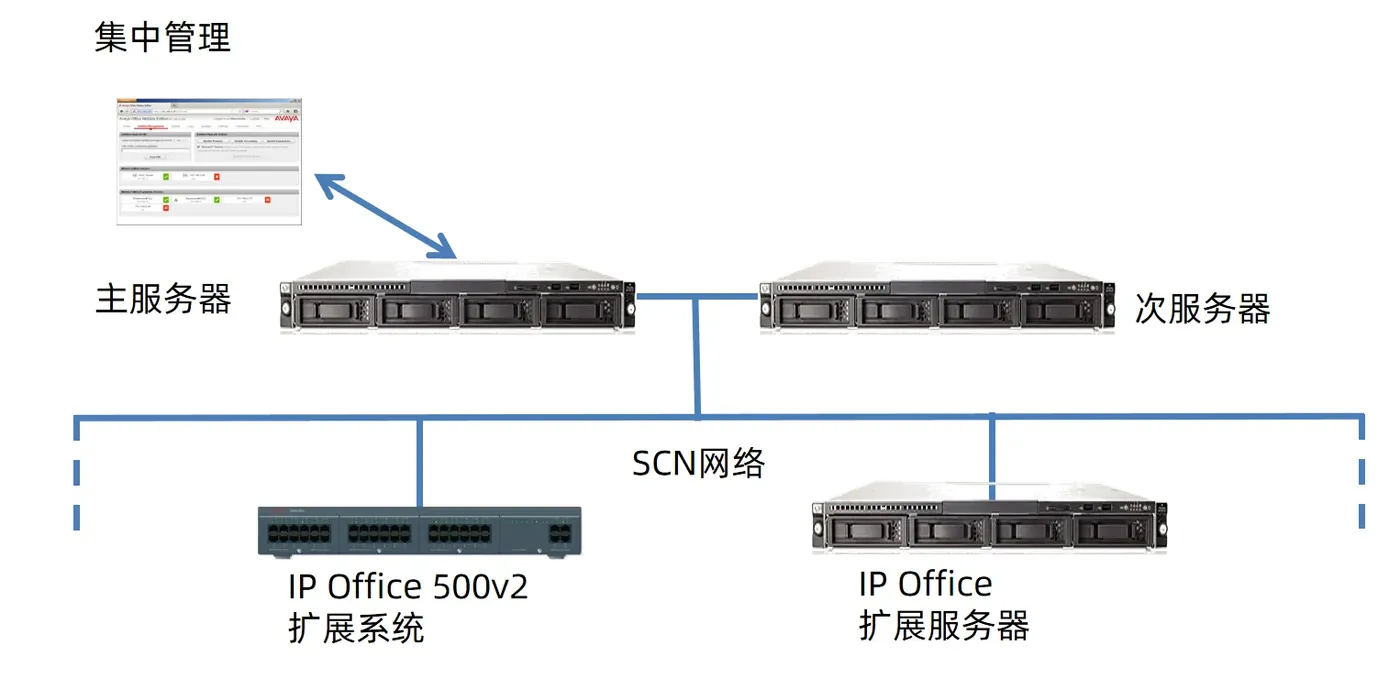
Server Edition is the software-based form of IP Office for mid-size and multi-site enterprises: a Linux-based Primary server sits at its core, with Secondary and Expansion servers attached as required, covering 100 to 2,000 users. It can be installed directly on a customer-supplied physical PC server or deployed on virtualization platforms such as VMware ESXi, Microsoft Hyper-V, Azure, Amazon Web Services or KVM, reusing existing resource pools and operational processes.
All servers run the same IP Office software; each server's role in the network (core IP Office services, voicemail, one-X Portal and so on) is chosen at installation. The same software supports both Server Edition and larger modes such as IP Office Select, protecting existing deployment and operational expertise.
Deployment and high availability
Server Edition supports active/standby redundancy: if the primary server fails or the WAN link splits, a Secondary server takes over to maintain service continuity. Together with virtualized HA deployment and scale-out to as many as 32 nodes, it meets the needs of multi-site and multi-datacenter networks.
- Primary plus Secondary server failover, covering disaster recovery in split-WAN scenarios
- Virtualization platform high availability (HA), deployed on customer-supplied standard servers
- Single-site or scale-out to 32 nodes, supporting up to 2,000 users
- Offline and online configuration modes; configurations can be prepared ahead of cutover and synchronized with the live environment
Unified management platform
Server Edition provides a complete management toolchain, from Windows Manager to pure browser access, so experts and managed partners can operate multi-site solutions from a single view.
- Server Edition Manager: centralized configuration, template-driven bulk provisioning of users / extensions / hunt groups, and solution-level configuration validation
- Web Manager: browser-only management with no Windows PC required; fine-grained permissions for large customers and cloud deployments
- System Status Application (SSA): real-time and historical status, alarms and QoS (jitter / latency / packet loss) monitoring, up to 2 concurrent sessions
- SysMonitor: protocol-level packet capture and alarm logs for troubleshooting complex faults
- SNMP: integration with third-party management systems (such as CastleRock SNMPc and HP NNM), with event alarms pushed by email
- Customer Operations Manager (COM): centralized multi-customer backup, upgrades and health dashboards for the subscription model
Key features
- Voicemail Pro: basic voicemail is included by default, with call recording, graphical call flows and conditional routing
- Conferencing: built-in conference bridge with up to 256 conference parties per server
- Unified communications and collaboration: one-X Portal, Avaya Workplace client, and mobile and remote worker capabilities
- Softphone: employees use the full set of telephony features on a PC or mobile device, ideal for distributed teams
- Contact center: optional Avaya Contact Center Select (ACCS) with skills-based routing, reporting and unified agent management across voice and multimedia
- Directory integration: LDAP and Microsoft AD integration with automatic synchronization of employee information
Specifications
| Item | Specifications |
|---|---|
| Product positioning | The server and virtualised deployment form of the IP Office platform |
| User capacity | Up to 2,000 users |
| Site capacity | Single site or up to 32 nodes |
| Voicemail channels | 150 |
| Recording channels | 150 |
| Conferencing | 256 parties |
| Extension groups / paging groups | 300 extension groups; 256 paging groups |
| Music-on-hold sources | 32 |
| Softconsole | 32 |
| Virtualization platforms | VMware ESXi、Microsoft Hyper-V、Azure、Amazon Web Services、KVM |
| High availability | Supports virtualized HA deployment on customer-supplied standard servers |
| Centralized management | Unified web management interface; the System Status application monitors system performance and potential problems |
| Directory integration | Integration with LDAP and Microsoft AD for storing and synchronizing employee information |
| Contact center reporting | Built-in ICR: web-based agent call control with real-time and historical reports for supervisors |
| Overall platform capabilities | Up to 3,000 extensions across 150 sites with redundancy; mixed TDM and IP trunks; built-in IP routing, switching and LAN/WAN firewall |
Licensing and subscription models
IP Office features and applications are enabled through licenses or subscriptions. Subscription is billed monthly, and the system periodically contacts Avaya subscription services to validate entitlements; if the connection to the subscription server is lost, the system continues to run on acquired entitlements for 30 days, raising daily alarms that clear automatically once the connection is restored. New systems can also run in Trial mode for up to 30 days to support pre-deployment evaluation.
Supplementary official documentation (IP Office R12.3)
The following material is compiled from Avaya official overviews and specification documents to supplement version, component relationship and deployment details; refer to the original documents for definitive capacity and compatibility matrices.
- The R12.3 (2026-04) document describes the IP Office Platform as a modular telephony system supporting mobile and distributed working, with voice and video on a wide range of devices.
- Deployment can range from a simple appliance to virtualized software, depending on the infrastructure available.
- The document includes a chapter on IP Office Server Edition components, and another on centralized and nodal licensing.
- Server specifications appear on page 123 of the document, and SIP (Session Initiation Protocol) trunking on page 137.
Document source and download
The official document referenced here is Avaya IP Office Platform Solution Description R12.3 (2026-04); the original PDF can be obtained under Product Literature in this site's Downloads section.