
Product overview
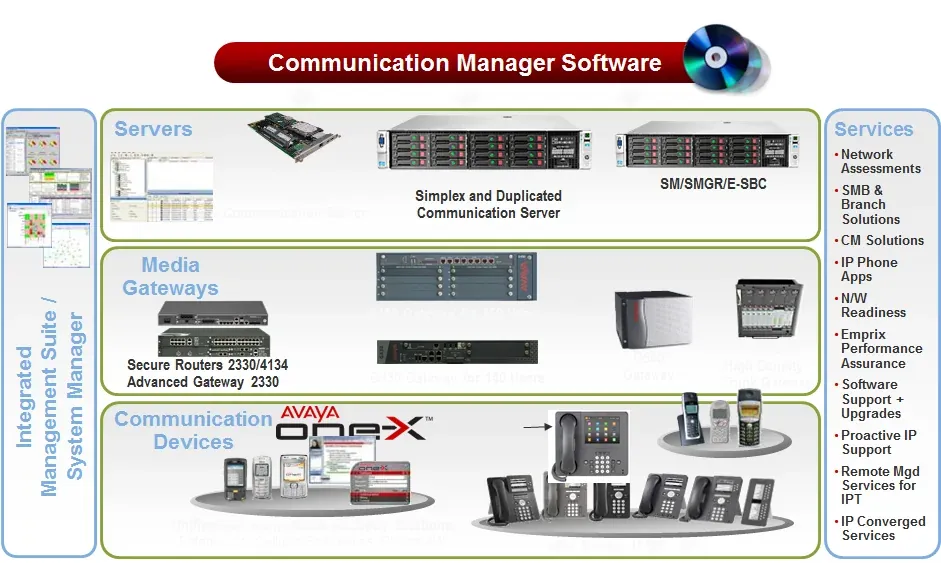
Avaya Aura Communication Manager is Avaya's open, highly reliable and scalable IP telephony core. It delivers intelligent communications for large and mid-size enterprises as the central component of the Avaya Aura platform, carrying real-time voice, video, messaging and mobility services.
Communication Manager provides centralized call control for distributed gateways and a wide range of analog, digital and IP communications devices, with built-in mobility, contact center, advanced conferencing and E911 capabilities, and supports industry-standard protocols such as SIP and H.323.
Scale and architecture
- A single system scales from fewer than 100 users to 41,000 users; one Communication Manager supports up to 18,000 concurrently registered H.323 terminals (41,000 terminals in total) plus enterprise SIP endpoints
- Avaya Aura as a whole supports up to 28 Session Manager instances, 300,000 users and 1,000,000 devices
- Call admission control (CAC) for converged voice and video, plus SIP features including E911 with calling party desktop location reporting
- Included in all Avaya Aura editions and licensed per user
Management and operations
- Multiple management interfaces: SAT (System Access Terminal, the screen-based terminal used for traffic and administration work), SMI (System Management Interface, graphical) and centralized System Manager
- Global Session ID (GSID): generates a unique 128-bit identifier for each point-to-point session and writes it into the request header, so tracing tools can filter logs by GSID when troubleshooting call flows
- Supports automatic call distribution (ACD), emergency calling services, alphanumeric URI dialing and SIP trunk optimization
High availability and disaster recovery
- Alternate gatekeeper: provides survivability between Communication Manager and IP telephones or soft clients
- Automatic fallback of branch gateways to the primary, and connection preserving failover and failback
- Survivable Core, Survivable Remote and survivable processors (ICC with an embedded branch gateway) recover automatically when the network splits or the main server fails
- IP endpoint time-to-service (TTS / TTS-TLS): an endpoint counts as in service as soon as it registers, shortening registration and re-registration for large IP endpoint fleets
- Dial plan transparency, automatic correction of split registrations and power failure transfer
Open interfaces and customization
- APIs are provided for third-party software to work with Communication Manager; client developers can build applications on those APIs
- Application Enablement Services (AE Services) connects applications to CM, so new applications can be built without changing CM or exposing proprietary interfaces
- Device and media control API (DMCC): clients can register as IP extensions and exercise first-party call control
- TSAPI (a CTI open interface based on the ECMA CSTA standard) and JTAPI (integrated with CM ASAI)
Attendant console and localization
- Avaya Workplace Attendant: a Windows soft client (SIP signalling plus Breeze snap-in managed call queues) with call preview, priority queuing, presence integration and multi-database synchronization (Active Directory, Open LDAP, Oracle, MySQL and others)
- Manageable language display: SIP, DCP and H.323 telephones can show messages in the user's language (English, French, Italian, Spanish, user-defined or Unicode), which requires a 40-character display
- Manageable loss plans and Bellcore calling name identification meet localization requirements in different countries and regions.
Supplementary official documentation (Aura R10.3.x)
The following material is compiled from Avaya official overviews and specification documents to supplement version, component relationship and deployment details; refer to the original documents for definitive capacity and compatibility matrices.
- The R10.3.x documentation defines Communication Manager as the core component and call processing foundation of the Avaya Aura platform.
- The documentation states that a single Communication Manager scales from fewer than 100 users to 41,000 users.
- The IP Server Interface (IPSI) is no longer supported from R10.2; gateways that depend on IPSI, such as G650, MCC, SCC and CMC, do not apply to R10.2 and later.
- From R10.3.x, System Manager Solution Deployment Manager is no longer provided.
- The official documentation lists the supported platforms for software-only and IaaS deployment models, and notes that Microsoft Azure, Google Cloud Platform and IBM Cloud are not on the supported list.
Document source and download
The official document referenced here is Avaya Aura Communication Manager Overview and Specification R10.3.x (2026-09); the original PDF can be obtained under Product Literature in this site's Downloads section.