
Product overview
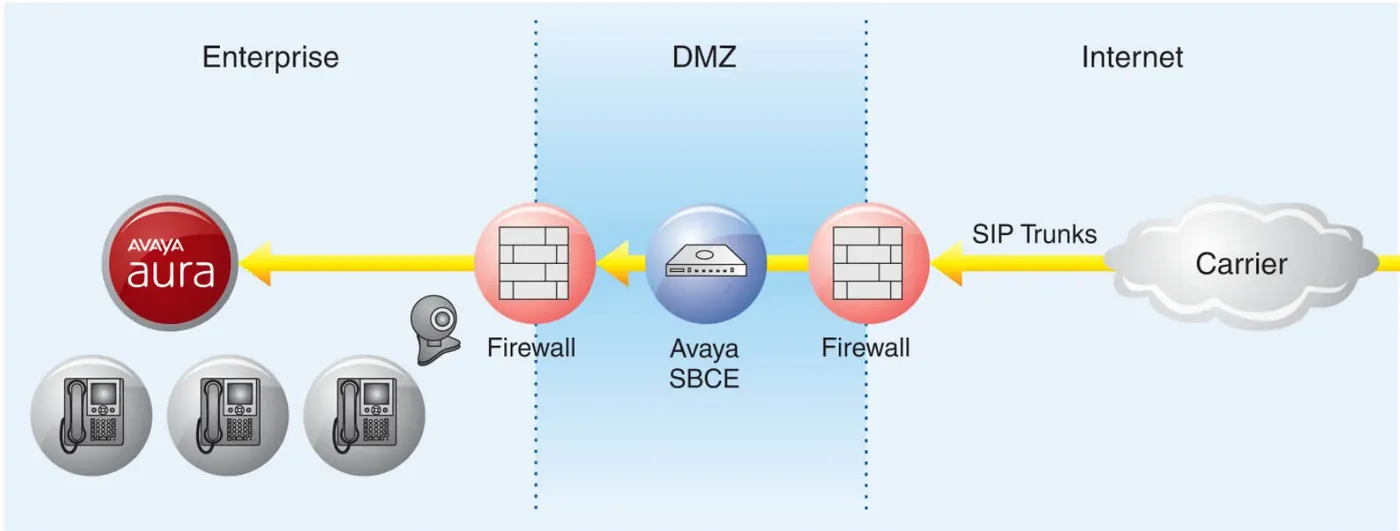
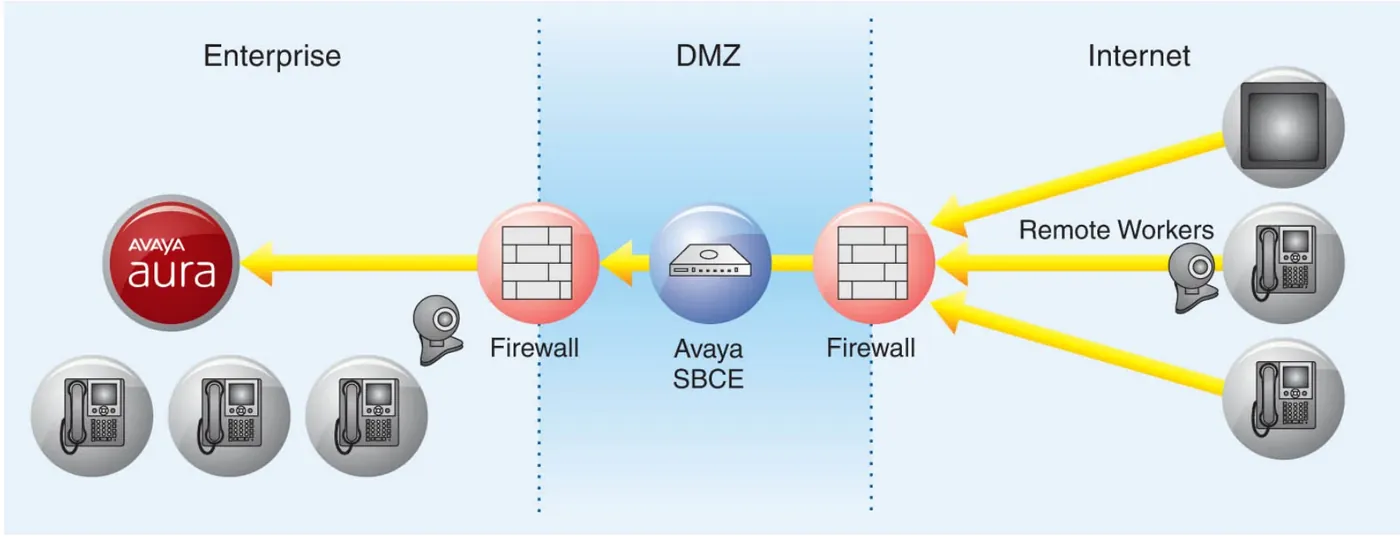
Avaya SBCE (Session Border Controller for Enterprise) provides security for SIP-based unified communications (UC) networks and sits at the enterprise network edge to protect core communications infrastructure. SBCE comprises two main components: the Element Management System (EMS), which handles management, and the SBC, which handles call processing.
Two editions
- Standard Services: a streamlined capability set for enterprises terminating SIP trunks, a true enterprise SBC rather than a rebadged carrier SBC, with low cost and easy installation and management; the unique SigMa (Signaling Manipulation) module greatly simplifies SIP trunk integration, and most standard configurations can be deployed within 2 hours
- Advanced Services: a dedicated UC security product that protects all IP-based real-time multimedia applications, endpoints and network infrastructure against denial of service, teardrop, IP sweep and similar attacks, combining protocol anomaly detection with behavior-learning-based anomaly detection
Core security functions (the three elements of signaling, media and intelligence)
- Signaling element: a proxy deployed in the network edge DMZ with end-to-end latency below 2 ms; provides inline signaling decryption and secure key management (TCP/TLS), SIP source rate limiting and policy enforcement, DoS/DDoS detection and protection, protocol and message sequence anomaly detection, NAT/firewall traversal, domain policy filtering, and spoofing and machine-generated call (MCD) detection
- Media element: the RTP media protection subsystem, providing media policy enforcement, RTP anomaly detection, timing and bandwidth validation, and fax/modem tone detection
- Intelligence (network element and management configuration): aggregates events and alarms, maintains calling party trust scores, white and black lists and the primary store of callers and domains, and maintains behavioural models per user, per caller and per network element by time of day and day of week
Deployment forms and high availability
- Three deployment configurations: standalone (EMS and SBC on the same server), multiple server (EMS and SBC separated) and high availability (paired active/standby SBCs controlled by a single or replicated EMS)
- In non-HA multiple-server mode, up to 24 standalone SBCs can be managed; in HA mode, one EMS (or an EMS active/standby pair) can manage up to 12 pairs of SBC servers
- HA failover relies on heartbeat links (M2) and GARP support; when the active SBC fails, the standby announces the new MAC by GARP and takes over the shared IP
- New in Release 10.1.x: single IP support, Red Hat Enterprise Linux 8.4, TLS 1.3, JITC compliance (listed on the DoDIN APL), high availability on Google Cloud Platform, automatic source IP blacklisting and RTCP-Mux
Deployment modes and platform support
- Two-wire (inline) deployment: the simplest basic topology, with SBCE connected directly at the DMZ network edge, providing internal and external firewall and NAT traversal, access control and intrusion prevention; signaling over TLS and media over SRTP encryption
- One-wire (screened subnet) deployment: SBCE sits in the enterprise DMZ but is not directly connected to the call server, acting as the next hop for SIP traffic
- Supports hardware (Dell PowerEdge, Avaya Solutions Platform 110 and others), VMware virtualization (vAppliance OVA with vMotion and cross-datacenter HA), KVM, Amazon Web Services, Google Cloud Platform and Microsoft Azure
Supplementary official documentation (SBCE 10.1.2)
The following material is compiled from Avaya official overviews and specification documents to supplement version, component relationship and deployment details; refer to the original documents for definitive capacity and compatibility matrices.
- The 10.1.2 documentation states that Avaya SBC provides security capabilities for SIP-based unified communications networks.
- The system has two main components: the management system EMS (Element Management System) and the call processing system SBC.
- Different deployment configurations can be chosen to suit network size and business needs.
- The document includes capacity and scalability specifications (page 84) and DoS security features (page 104).
Document source and download
The official document referenced here is Avaya Session Border Controller for Enterprise Overview and Specification 10.1.2; the original PDF can be obtained under Product Literature in this site's Downloads section.